Showing posts with label visualizing information. Show all posts

11/5/13

Thanksgivukkah

If you've been online at all this month, you can't have missed reading about Thanksgivukkah -- the newly-minted holiday located at the freak intersection of Thanksgiving and Hanukkah this Nov. 28.

Last year, Jonathan Mizrahi, a quantum physicist in Albuquerque, did the math and demonstrated (with graphs!) that the coincidence of Hanukkah on the lunar Hebrew calender and Thanksgiving on the solar Gregorian calendar is so rare that it will not happen again until the year 79,811 — and then only if the Jewish calendar is not somehow reset to ensure that Passover remains a springtime holiday. (yes, the Hebrew calendar is slipping, as this Jewschool post explains, in some detail).

It's all sort of silly, with a Facebook page dedicated to the faux holiday and widely-publicized foodie celebrations across the country creating Thanksgivukkah menus -- pumpkin-filled sufganiot in L.A., latke-encrusted turkey cutlets in San Francisco, and online recipes for kasha with smoked turkey, butternut squash in bourbon (Haaretz), latkes with cranberry applesauce, Maneschewitz-brined roast turkey, challah-apple stuffing, and roasted brussels sprouts with pastrami and pickled red onion. (Buzzfeed.com).

The most Thanksgivukkah-est city ever is Boston, where marketing specialist Dana Gitell first coined the term (if you need proof, just visit thanksgivukkahboston.com); Boston Mayor Thomas Menino has promised to proclaim Nov. 28 “Thanksgivukkah Day" throughout the city.

New England Jews can claim some interesting parallels between the the Pilgrims who settled their part of the country and the Maccabees -- both were, after all, activitists willing to risk their lives for religious freedom. Kol HaLev Education Director Robyn Novick pointed me in the direction of Deanna Mirsky's "The Truth About Pilgrims and Maccabees," which argues while the Plymouth Pilgrims didn't celebrate Hanukkah, they certainly knew about the Maccabees because the Pilgrims as dedicated scholars of Hebrew and Judaica. Mirsky asks us to think beyond turkey and cranberries this Thanksgiving: "Ask 'Mi yemalel?' ('Who can recount the brave deeds of Israel?'). And answer: 'They could and did at Plymouth.'"

Is there something more serious than humor and hype hiding behind this giddy explosion of culinary, scholarly and entrepreneurial energy? (Did I mention the kid who raised money on Kickstarter to produce a turkey-shaped hanukkiah called the menurkey?)

I'm thinking that there is, if only because the excitement which has bubbled up spontaneously around a more-or-less random mash-up of Jewish and American cultural narratives feels real. Joking aside, there's a reason Thanksgivukkah has fueled the imagination of Jewish America: it's because it expresses our legitimate pleasure in the good forturne of being a Jew in America, the one place in the Diaspora  -- and arguably in the entire Jewish world -- where, it is relatively safe -- OK, even a blessing! --  to be Jewish.

I'll say it:  The U.S. is still one of the best places in the world to be if you're a Jew-- otherwise, we'd all be lining up on the runway to make aliyah, and we're not.  And yet, it's no longer really OK to express this degree of unambivalent pleasure in being an American Jew. We're all supposed to want to end the diaspora and go "home" to a place the vast majority of us haven't come from, urged on by an unfortunate trend  in the larger Jewish world to characterize American Jews as cowards who lack the commitment to live as Jews in the place where it's really tough to be Jewish -- in Israel.

For generations, the de facto meme of Yiddish and Jewish-American song and literature was the celebration of American as the goldene medina (the golden country, though perhaps it never turned out to be golden in exactly the way one imagined back in the shtetl). In recent decades, however, songs of the golden streets of America have been drowned out by a different tune -- the cultural myth of the State of Israel as the only true apotheosis of modern Jewish life.

I'm not trying to be controversial, really. All I'm suggesting, is that the wildfire popularity of Thanksgivukkah among American Jews reveals our secret wish to be allowed to be American, to take a break from "Next year in Jerusalem" and celebrate the the fact that right here, right now -- and for some of us, going back several generations -- the land of the Pilgrims has been pretty good to us.

Read more...

New media presents new opportunities: cardsofchange.com

5/20/09


Cardsofchange.com is sure to be a cheering sight for the recently laid off. It's also a cheering site: a place to share new projects and accomplishments that came into being only because the unthinkable -- unemployment -- happened. The site's founders explain that:
Cardsofchange is a place where the glass is always half-full. A destination where all the bad news of the day takes a back seat to stories of individual success.

Our mission is to collect as many business cards and stories of positive change of people who have recently been laid off and connect them with new opportunities from potential employers, business partners and people who make the effort to look on the bright side of life.
The recently downsized (RIFfed, laid off, terminated) are invited to
Take your old business card and scratch out your old contact info. Then write in your new email address along with 1 positive change that happened in your life as a result of being downsized. Take a landscape photo and upload it here.
The collection of cards is just beginning, but there are quite a few creative entries. Some of my favorites:


Read more...

Obama's first 100 days: the Facebook feed

4/30/09

The Facebook feed and the twitterstream are a real boon to parodists everywhere. Nothing deflates an important topic quicker than reducing it to one-liners and interpersonal relationships. Poke!

Slate.com offers this "100 days of Obama's Facebook news feed" by Slate political reporter Christopher Beam and assistant editor Chris Wilson.


Sorry if these snippets are too blurry to read: take a quick hop over to the Slate.com to read the entire piece without squinting.

Read more...

The future of writing in a readerless world: two takes

4/23/09


Change in language is, however, inevitable, just as it is in all other aspects of reality.


Technology is just evolution by non-biological means.


Before I wrote "Writing Well for Social Media" (a chapter for the Cleveland Social Media Club's ebook) I began been tracking the jokes about, polemics against, and advice for writing online.

Let's leave aside the cranks who claim that "Generation Text" is "ruining English" by (wittingly or unwittingly) using texting shorthand in their term papers. (The term paper written entirely in "txt spk" and posted to the internet turned out to be a hoax.) The research shows that in fact better writers than those in the past ("using far more complex sentence structures, a wider vocabulary and a more accurate use of capital letters, punctuation and spelling").

Yes, Virginia, the world still does need writers, although the nature of the writing they produce continues to change to meet the needs of the people formerly known as "readers" and now known as "scanners," "followers" (twitter), "recipients" (email), "connections" (LinkedIn) or "friends (Facebook)."

Whether the redefined future of the online writer excites or horrifies you depends entirely on your faith in the potential of links, interrelated data sets, mashups and other nonlinguistic tools to provide the depth that bullet points and 140-characters sound bites obviously cannot.

Two recent blogs posts depict the future of writing in a world of scanners. In "Writing for Nonreaders in the Postprint Era, Robert Lanham mocks new developments, while in "Axioms for 21st Century Media," Dan Conover embraces them. But their visions of the written word's future are remarkably similar. In the future, the word will be referential, decentralized, truncated, and yoked to other media, other ways of conveying information.

From McSweeney's Internet Tendency (all emphases are mine):
INTERNET-AGE WRITING SYLLABUS AND COURSE OVERVIEW.
BY ROBERT LANHAM

ENG 371WR:
Writing for Nonreaders in the Postprint Era
Instructor: Robert Lanham

Students will acquire the tools needed to make their tweets glimmer with a complete lack of forethought, their Facebook updates ring with self-importance, and their blog entries shimmer with literary pithiness. All without the restraints of writing in complete sentences. w00t! w00t! Throughout the course, a further paring down of the Hemingway/Stein school of minimalism will be emphasized, limiting the superfluous use of nouns, verbs, adverbs, adjectives, conjunctions, gerunds, and other literary pitfalls.
Among the prerequisites:
ENG: 232WR—Advanced Tweeting: The Elements of Droll
LIT: 223—Early-21st-Century Literature: 140 Characters or Less
ENG: 231WR—Facebook Wall Alliteration and Assonance
LIT: 202—The Literary Merits of Lolcats
LIT: 209—Internet-Age Surrealistic Narcissism and Self-Absorption
Required Reading: "Literary works, including the online table of contents of the Huffington Post's Complete Guide to Blogging, will serve as models to be skimmed for thorough analysis. Also, Perez Hilton's Twitter feed." A typical unit:
Week 6: 140 Characters or Less

Students will acquire the tools needed to make their tweets come alive with shallow wit. They'll learn how to construct Facebook status updates that glitter with irony, absurdity, and dramatic glibness.

Attendance: Unnecessary, but students should be signed onto IM and/or have their phones turned on.
Dan Conover's insights in "Xark! Axioms for 21st Century Media" is very Web 2.0, boiled down to pithy axioms presented in a numbered list:

  1. The present is functionally obsolete.
  2. For planning purposes, the short-term future IS the present.
  3. Planning for the short-term is not a strategy. It's like navigating solely by what you can see.
  4. There is no map, and the future is not predictable. Consequently, shoot for standard formats (XML, RDF, etc.) and build products and systems to be adaptable and inter-operable.
  5. Don't build your future on a rock. Build your future on a surfboard. We're not on dry land anymore.
  6. Proprietary systems are rocks. Open Source systems are surfboards.
  7. Own your data.
  8. Think databases, not documents.
  9. Unstructured data has a value that approaches zero as it ages.
  10. Structured data is too formal to describe the messy world around us.
  11. Semi-structured data looks like the Goldilocks Zone for news media.
  12. The One With The Best Tools Wins.
  13. Web 1.0 is to the Web as rotary phones are to telecommunication: Rotary phones still work, but they're irrelevant to what comes next.
  14. The challenge is: Build tools that give humans superhuman abilities.
  15. Technology is just evolution by non-biological means.

Read more...

Easter / Passover Mashups, Part II: Barbie buys matzah

4/15/09

As I wrote in Easter / Passover Mashups, Part I: Passover Peep Panoramas, I've always liked the hands-on craftiness of coloring Easter eggs, and although I don't celebrate Easter, I have been known to put out on my seder table a plate of hard boiled eggs bearing brightly-colored eggs shells.

So naturally I'm a fan of other mashups of seasonal Jewish and Christian cultural vocabularies, like the DIY Tiny Matzah box for Barbie which Hatam Soferet posted on Jewschool.


She writes:
To make your own box of Barbie matzah you will need:
Measure, mark, and cut four pieces of corrugated cardboard 30mm*27mm. Tape them together in a bundle. These are your matzot (hahaha, insert matzah/cardboard joke of choice here).
For the complete directions, you must visit her post.

Hatam Soferet, aka Jen Taylor Friedman by the way, is the creative mind behind Tefillin Barbie. A sofer, she's the first woman known to have written a sefer Torah.

Take a look at her project and what she has to say about being a female sofer. It's all on her website:

"Tefillin Barbie generated an extraordinary amount of feedback. She featured on Jewschool and Jewlicious, on BoingBoing, in the Jewish Journal of Greater Los Angeles, on Ritualwell, Lilith magazine (Winter '06-'07 issue), New Voices, the London Jewish Chronicle, The Jewish Advocate, the Philadelphia Jewish Voice, the New Jersey Jewish News, the Forward, the Jewish Week..."

Read more...

Easter / Passover Mashups, Part I: Passover Peep Panoramas

4/14/09

A Very Peeps Passover by Nycole Klein and Chris Patton, placed 32nd in the Washington Post's 3rd Annual Peep Show. "Our Peeps have sat down to a traditional Passover Seder, complete with the requisite Passover Haggada (prayer book), Seder plate, candles, matzo and lots of wine. As an added bonus, the Afikomen is hidden somewhere in the room!" says Klein.


've always liked the hands-on craftiness of coloring Easter eggs, and although I don't celebrate Easter, I have been known to put out on my seder table a plate of hard boiled eggs bearing brightly-colored eggs shells.

So naturally I'm a fan of other mashups of seasonal Jewish and Christian cultural vocabularies, like the above panorama of a Pesach dinner attended by Peeps®. (Gives the expression "my peeps" a whole new meaning, doesn't it?)

Peeps®, if you don't know, are bizarre little marshmallow candies traditionally shaped like little yellow chicks and popular at Easter.


According to Wikipedia, theyare made from marshmallow, sugar, gelatin, and carnauba wax, but they have a distinctly unfoodlike texture. In 1999, scientists at Emory University performed experiments on batches of Peeps® to see if they really are indestructable: "They claimed that the eyes of the confectionery 'wouldn't dissolve in anything.'"

Their apparent indestructability and their excessive cuteness challenges people to desecrate them, and so many bricoleurs have tried their hands at making Peeps® dioramas that newspapers now hold annual contests. (These are not to be confused with "Peep Offs," where contestants compete to choke down the greatest number of stale Peeps.)


Writing on Jewschool,feygele called our attention to flickr user stylecouncil1's wonderful Peeps for Passover, a series of photos of the ten plagues as performed by Peeps®.


Chag Sameach Pesach!

Read more...

Ohio's stimulus & unemployment, visualized

4/8/09

The brilliant folks at Mint.com were looking at the map and tables at ProPublica and started wondering "exactly what percentage of each state’s unemployment problem would be hypothetically solved by the total stimulus package."

They came up with this map. (Click on images to go to the full-size version on Mint.com's website.)


They do warn it is difficult to peg down the actual unemployment rates, referring reader to a previous posting, the recent Visual Guide to Unemployment. It's entertaining as well as informative, particularly if you fall into the category of underemployed or discouraged workers.


According to the graph, Ohio stands to recoup 31% of its lost jobs. If, that is, the laid off auto workers and waitresses and lawyers and journalists can be retrained to lay blacktop.

Read more...

A really big shoe for you... statue honoring man who threw shoes at Bush erected in Saddam's hometown.

1/30/09


File under:
Ars longa, vita brevis.

From the Daily News:
Many Iraqis considered it poetic justice when a journalist tossed his shoes at President George W. Bush last month.

Now the bizarre attack has spawned a real life work of art.
A sofa-sized statue of the shoe was unveiled Thursday in Tikrit, the hometown of the former Iraqi leader Saddam Hussein.

Baghdad-based artist Laith al-Amari described the fiberglass-and-copper work as a tribute to the pride of the Iraqi people.

The statue is inscribed with a poem honoring Muntadhar al-Zeidi, the Iraqi journalist who stunned the world when he whipped off his loafers and hurled them at Bush during a press conference on Dec. 14.

In the Arab world, even showing someone the sole of a shoe is considered a sign of disrespect.

h/t @Mickeleh
("From the "greeted as liberators" division")/

Read more...

Morphing and change: 44 US Presidents - George Washington to Barack Obama

1/9/09

I find this video -- 44 US Presidents from George Washington to Barack Obama morphed to the music Boléro by Ravel -- absolutely mesmerizing.


Morphing is, in essence, movement. Paced to the hypnotic beat of Ravel's Bolero, this is a graceful (and thought provoking) example of what is still a relatively new form of of kinetic art. (There's a subsequent version of the same visuals set to Nirvana's Rape Me. Not as successful.)


At first look, the fluid morphing draws attention to features of our presidents' visages hitherto unnoticed (at least by me), (You'll find yourself thinking things like, "My god, his nose was HUGE" and "Well, HE could never have been elected in the age of television").

The video's final message -- "Change can happen" -- refers, of course, to the skin color of our newest president. But oddly enough, I found that the overall trajectory of the video led me to notice the similarities among these faces rather than differences.

For me, the visual differences between the faces of George W. Bush and Barack Obama are far less startling than the differences between, say, Dwight Eisenhower and John F. Kennedy. Was there a morph that caught your eye that way?

It's a reminder that human beings tend to oversimplify identity. Yes, skin color is of signal importance in determining racial/cultural identity in America (as Obama's book makes clear). But it's certainly not the only or even the primary visual marker we could focus on.

Speaking genealogically, there are good reasons that Obama might look more like his 43 predecessors than you might expect. Obama and Bush are 11th cousins, sharing common ancestors Samuel Hinckley and Sarah Soole Hinckley of 17th century Massachusetts.

Obama's distant cousins also include Gerald Ford, Lyndon Johnson, Harry S. Truman, James Madison, Winston Churchill and Robert E. Lee. Scarily enough, Obama and Dick Cheney are 8th cousins, related through Mareen Duvall, a 17th century immigrant from France.

In terms of the visualization of information, morphing has tends to de-emphasize visual difference. If, on the other hand, you want an image that emphasizes Obama's differences from his predecessors, here it is:

P.S. Want to try your hand at morphing? Try the online tool Morphthing.

Read more...

Now, Voyager: Track your kink on the Map of Human Sexuality (NSFW)

11/22/08

*NSFW=not safe for work


Hattip to whoever tipped me off to this ingenious "Map of Sexuality," created by graphic designer (and polyamory advocate) Franklin Veaux.

Located on the website of SymToys, the map is interactive: Users can create a personalized sexuality map by placing flags marked "Things I've Tried' and "Things I'd Like to Try."

It's like a mashup of Google Maps and the Good Vibrations Guide to Sex, except that the geography is completely made up and the sexual practices listed far exceed the Good Vibrations' repertoire.


You can mark what you've done and what you'd like to do, then embed your personal map on your blog as, I suppose, a kind of brag sheet, or a to-do list for the next person you plan to sleep with.

Or you can give your friends the choice to learn what might turn out to be TMI about you by posting a widget to your blog. Viewers click on the widget if they want to know more. (Don't worry, clicking on the widget below takes you to a BLANK map that will reveal nothing about my sex life. Not that I couldn't mark the hell out of that map...)


Find out where I've journeyed on the
Map of Human Sexuality!
Or get your own here!


But you should definitely visit the full-size map yourself and marvel over the clever topography. There will be stuff you never heard of, and stuff no one you've ever known has ever heard of, but the truly compelling thing is how Veaux has laid out various sexual predilections in relationship to one another.

For instance, most people probably start their journey in the sourtheast corner of the map, in the Land of Mundania, which is just across the Vanilla Sea from the Island of Sexual Phobias. To get to the Homosexual Homeland, one must navigate the Straits of Fear.


At the other end of the spectrum, in the northernmost part of the map is an area that lies beyond a mountain range known as The Impassable Reaches. On their far side is where you'll find -- if you're looking for them -- Incest, Snuff Films and Cannibalism. Note that some kinks you may have heard about lie solidly in the Land of Myth on the shores of the Urban Dictionary Bay.

And no, I don't know what many of these mean, so please don't ask me.
And if you know, please don't tell me.

Here's the whole map, but the actual site is much easier to read.


Read more...

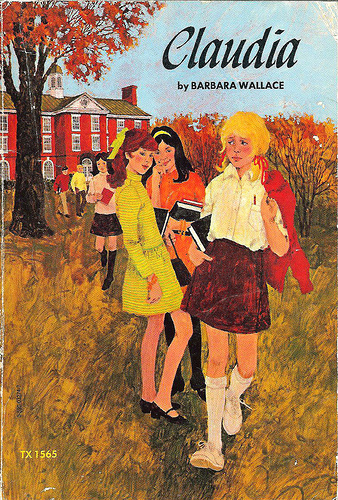
Cheap & easy: Scholastic Books covers of the '60s & '70s

11/14/08


I can say with certainty that I am more always more excited when the Scholastic Books order forms come home than my kids are.

I've always loved Scholastic Books. One of the first ones I got was a cookbook for kids which contained the recipe for the first supper I ever cooked: pigs in a blanket.

It was with great pride that I stretched those Pillsbury refrigerator rolls around the hot dogs and put them on a foil-lined pan. (OK, so I used a dish towel instead of an oven mitt when I took them out of the oven and the fringe caught fire a little! So what?)

Recently collections of vintage Scholastic Books covers have been popping up online, annotated with the fond memories of the adults who found them at garage sales, scanned and uploaded them. (See links below.)

They're not exactly what you'd call rare books, although people do collect them and sell them on ebay.com. Their longevity isn't so great; the paper yellowed quickly and the covers were easily wrinkled and dog-eared. Scholastic Books' goal was to print cheaply and disseminate widely.

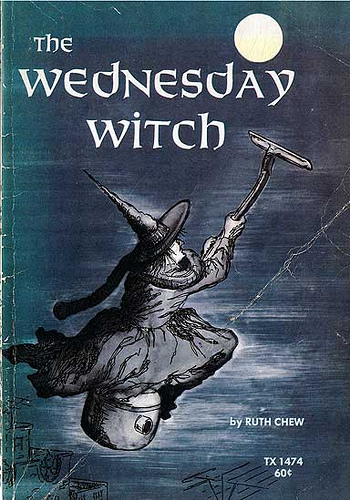
But even as a child, I felt that the stories and cover art tended toward the melancholic. Sure, there were lighthearted stories and emotionally-neutral educational stories: Henry and Ribsy, Encyclopedia Brown, Miss Pickerell Goes Undersea.


But a lot of them were scary or sad, some truly scary and others only superficially so. I was partial to the quasi-scary supernatural mysteries and ghost stories.


And (for reasons that will remain between me and my therapist), I bought a lot of books about Cinderella types and ostracized school girls.


Evidently grownups didn't find these stories particularly dispiriting.

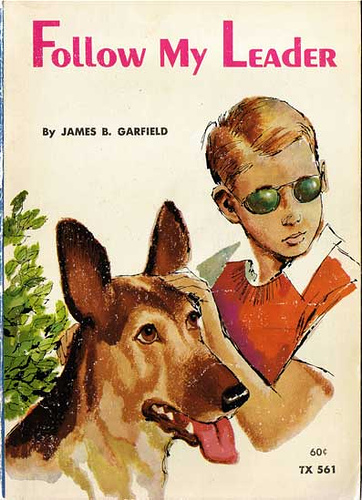
My fourth grade teacher read us Follow My Leader, the story of a boy who picks up a "dud" firecracker only to have it blow up in his face and blind him.

My memory of the book is grueling descriptions of the blinded boy's experience of darkness, helplessness, despair, and loneliness -- until he gets Leader, his seeing eye dog. (And there's still some trouble after that.)

The experience was redeemed by a real-life visit from a local woman who had a seeing eye dog, an Irish setter named "Rusty." I thought Rusty was magnificent, a real hero, for giving up the doggyish joys of romping around and being petted by kids like myself in order to lead his mistress safely through life.

To this day, I'd like to get a dog and name him Rusty. And I won't ever touch a firecracker.

There are about 60 images of Scholastic book covers and illustrations in jl.incrowd's photostream Nostalgia for the Scholastic Book Club, circa '60's & '70's. and another 15 or so in Brent Cox's photostream.

If anyone comes across a Scholastic cookbook for kids with a pigs in blanket recipe, let me know.

Read more...

Visible unity: from 52 to 48 with love

11/9/08

Over at the quirky blog zefrank.com, readers are invited to submit messages of unity between Obama supporters (52% of voters) and McCain supporters (48% of voters).

From 52 to 48 with love

i would love to see a group project where obama supporters reached out to the mccain folk (and others) in a gesture of reconciliation...

simple messages.
perhaps it is naive. the differences are real, i know. but we have to repair the damage done from this election cycle somehow...
the fringes (all of them) have been allowed to dominate our conversations for too long. to create a cycle of hate, ill-will and revenge.
it's a tough and delicate challenge - if you want to try it - send a pic of you with a sign, or a vid, or anything to ze@zefrank.com
maybe it works, maybe not - i know it won't speak to many : but i think we give it a whirl and decide for ourselves, yes?

from52to48withlove
Go see the rest of the images, and if you're inspired, make one yourself.


Technorati tags:

Read more...

  © Blogger template Columnus by Ourblogtemplates.com 2008

Back to TOP