Showing posts with label writing-blogging-reporting. Show all posts

Yo' (Jewish) Mama: Jewish Women's Archive starts Mother's Day image pool on Flikr

5/8/09

On Jewschool today Rabbi Danya Ruttenberg (author/editor of Yentl's Revenge, Surprised by God, and The Passionate Torah) posted a call for user contributions to a new Flikr photostream of images of "Jewish Mothers."

From Flikr:

Photo by Joyous Jewess

About Jewish Mothers: The Way We Were, the Way We Are

In honor of Jewish American Heritage Month and in celebration of Mother's Day, the Jewish Women’s Archive is creating a special photo collection on Flikr about "Jewish Mothers."

Photos can show a Jewish mother, now or in the past, in any context -- mothers at home or at work; mothers in the family and in the community; mothers of different generations and family constellations; formal portraits or candid snapshots.

How would you like to represent Jewish mothers?
Go here to see the set and to add images of your own.

Read more...

Not too accurate: Fox News now claims it is "fair, balanced, and ACCURATE"

5/5/09

(File under: Methinks they doth protest too much)


It stretches credulity, but Fox News has indeed added "accurate" to the claims of "fairness" and "balance" in its slogan.


The Daily Kos caught the new slogan in this new Fox ad. The ad, they say, is genuine (so no, it was not made by The Onion or the Daily Show for laughs).

Fox's claim to fairness and balance was already profoundly inaccurate. Add in the claim of accuracy and that makes them, well, just plain old big fat liars.


Read more...

The future of writing in a readerless world: two takes

4/23/09


Change in language is, however, inevitable, just as it is in all other aspects of reality.


Technology is just evolution by non-biological means.


Before I wrote "Writing Well for Social Media" (a chapter for the Cleveland Social Media Club's ebook) I began been tracking the jokes about, polemics against, and advice for writing online.

Let's leave aside the cranks who claim that "Generation Text" is "ruining English" by (wittingly or unwittingly) using texting shorthand in their term papers. (The term paper written entirely in "txt spk" and posted to the internet turned out to be a hoax.) The research shows that in fact better writers than those in the past ("using far more complex sentence structures, a wider vocabulary and a more accurate use of capital letters, punctuation and spelling").

Yes, Virginia, the world still does need writers, although the nature of the writing they produce continues to change to meet the needs of the people formerly known as "readers" and now known as "scanners," "followers" (twitter), "recipients" (email), "connections" (LinkedIn) or "friends (Facebook)."

Whether the redefined future of the online writer excites or horrifies you depends entirely on your faith in the potential of links, interrelated data sets, mashups and other nonlinguistic tools to provide the depth that bullet points and 140-characters sound bites obviously cannot.

Two recent blogs posts depict the future of writing in a world of scanners. In "Writing for Nonreaders in the Postprint Era, Robert Lanham mocks new developments, while in "Axioms for 21st Century Media," Dan Conover embraces them. But their visions of the written word's future are remarkably similar. In the future, the word will be referential, decentralized, truncated, and yoked to other media, other ways of conveying information.

From McSweeney's Internet Tendency (all emphases are mine):
INTERNET-AGE WRITING SYLLABUS AND COURSE OVERVIEW.
BY ROBERT LANHAM

ENG 371WR:
Writing for Nonreaders in the Postprint Era
Instructor: Robert Lanham

Students will acquire the tools needed to make their tweets glimmer with a complete lack of forethought, their Facebook updates ring with self-importance, and their blog entries shimmer with literary pithiness. All without the restraints of writing in complete sentences. w00t! w00t! Throughout the course, a further paring down of the Hemingway/Stein school of minimalism will be emphasized, limiting the superfluous use of nouns, verbs, adverbs, adjectives, conjunctions, gerunds, and other literary pitfalls.
Among the prerequisites:
ENG: 232WR—Advanced Tweeting: The Elements of Droll
LIT: 223—Early-21st-Century Literature: 140 Characters or Less
ENG: 231WR—Facebook Wall Alliteration and Assonance
LIT: 202—The Literary Merits of Lolcats
LIT: 209—Internet-Age Surrealistic Narcissism and Self-Absorption
Required Reading: "Literary works, including the online table of contents of the Huffington Post's Complete Guide to Blogging, will serve as models to be skimmed for thorough analysis. Also, Perez Hilton's Twitter feed." A typical unit:
Week 6: 140 Characters or Less

Students will acquire the tools needed to make their tweets come alive with shallow wit. They'll learn how to construct Facebook status updates that glitter with irony, absurdity, and dramatic glibness.

Attendance: Unnecessary, but students should be signed onto IM and/or have their phones turned on.
Dan Conover's insights in "Xark! Axioms for 21st Century Media" is very Web 2.0, boiled down to pithy axioms presented in a numbered list:

  1. The present is functionally obsolete.
  2. For planning purposes, the short-term future IS the present.
  3. Planning for the short-term is not a strategy. It's like navigating solely by what you can see.
  4. There is no map, and the future is not predictable. Consequently, shoot for standard formats (XML, RDF, etc.) and build products and systems to be adaptable and inter-operable.
  5. Don't build your future on a rock. Build your future on a surfboard. We're not on dry land anymore.
  6. Proprietary systems are rocks. Open Source systems are surfboards.
  7. Own your data.
  8. Think databases, not documents.
  9. Unstructured data has a value that approaches zero as it ages.
  10. Structured data is too formal to describe the messy world around us.
  11. Semi-structured data looks like the Goldilocks Zone for news media.
  12. The One With The Best Tools Wins.
  13. Web 1.0 is to the Web as rotary phones are to telecommunication: Rotary phones still work, but they're irrelevant to what comes next.
  14. The challenge is: Build tools that give humans superhuman abilities.
  15. Technology is just evolution by non-biological means.

Read more...

Newspapers: what happens when there's nothing left to cut?

3/11/09

When the human body runs out of runs out of glucose and fat to burn, it will burn muscle, tissues and organs. While preferable to immediate death from starvation, this catabolic state is hardly ideal -- no one can get stronger, smarter or more efficient when they're losing crucial biological capital.

And no media outlet has been able to put out a better newspaper once it began burning through crucial human capital.

I can't fathom how industry executives could have expected any other outcome: if you have few writers and reporters, you have less time for in-depth coverage, fact-checking and polished writing. Reducing the editorial pool limits your outreach into the community you cover, so you miss more stories and disappoint more readers.

Newspapers that cut editorial staff are slowly starving themselves to death. They'll still fail, but it will take longer and they will lose more money before it happens.

And so I was delighted to read on the Neiman Journalism Lab website this quote from Jim O’Shea, who was fired as editor of The Los Angeles Times in January 2008 for resisting staff cuts.
I long thought that the only way that you’re going to survive in this is you have to invest something in journalism.
...

You know, people have to understand something: newspapers are a manufacturing industry. And there’s just, at some point, you’re gonna cut it to the point where you won’t be able to get the thing out the door because you don’t have enough employees. And they’re getting dangerously close to that point right now, and I think that people like Russ have to struggle with that everyday. And it’s quite a struggle, but I think you’re getting to a point where, you know, newspapers are going to be a different industry, and they aren’t going to be able to produce the news that’s vital to a democracy if this continues.

I'm not sure what kind of divine or karmic retribution is owed to newspaper CEOs, publishers and business managers who've spent the last five years ignoring their editorial and art staffs' input about new media.

At the very least, they should lose their own jobs.

But surprisingly, few have. Reporters, editors and designers have been laid off in the hundreds; newsrooms have been retrenched.

But most newspapers' executive structure and decision-making process remains unchanged, even as the papers stumble and fail, even until the day the presses shut down and the doors close.

(To read the entire interview with John O'Shea -- and the editor who replaced him at the LA Times -- read O'Shea: "People have to understand something: newspapers are a manufacturing industry" at Nieman Journalism Lab)

Related posts: Newspapers: 10 reasons they can't be saved

Technorati tags: , ,

Read more...

The bell tolls on NPR today

12/10/08

Yesterday the bell tolled for the Chicago Tribune (Who knows who the Zell tolls for? He tolls for thee?). Today's surprising news is that the NPR news is also mourning.

Ironically, On today's Diane Rehm Show today, the where topic was The Newspaper Industry and The Future of Journalism, Clevelander Lauren Rich Fine offered NPR as a successful model business model for news. NPR, it was said, has been increasing its world coverage and its staff of foreign correspondents. (Listen to the podcast on RealAudio or Windows Media)

So it comes as a surprise to hear from @themediaisdying that there were "65 lay offs @ NPR by EOD - no digi media cuts - 34 gne in news inc Linda Wertheimer/Noah Adams/Howard Berkes out."

The tweets and retweets about the NPR layoffs are coming fast and furious...

FishbowlDC has the memo from Interim President and CEO Dennis Haarsager, in which he writes:

The manageable $2 million budget deficit we projected in July for Fiscal Year 2009 has now risen to a projected $23 million deficit.
...
[W]e are announcing the cancellation of News & Notes and Day to Day, and significant budget reductions across the organization. These cuts include the elimination of 64 filled and 21 unfilled positions, many of which are associated with the two cancelled programs. Positions have also been eliminated across NPR, including reporting, editorial, and production staffs; station services; digital media; research; communications; and administrative support. Overall, this is a 7% reduction in NPR's current workforce.

Update from FishbowlDC
@3:24 p.m.: "NPR sources told us that Linda Wertheimer and Noah Adams were among the casualties in today's staff slashing, but the news organization has assured staffers that the two will remain."

Part of the problem, according to coverage of the layoffs from NPR, is that "Interest payments from an endowment created from the bequest of the late Joan B. Kroc, which have typically paid out about $10 million a year to NPR, were wiped out by the sharp downturn in the financial markets."

Read more:

Washington Post's coverage: Hit by Recession, NPR to Lay Off Seven Percent of Staff
NPR's coverage: NPR announces cuts to staff, programs
NPR's press release

Read more...

The Bad Sex in Fiction award goes to ...

11/24/08

As an MFA student in Cornell's creative writing program, I once attended a poetry reading where a famous poet read a poem containing this climactic line: "He pumped his brine into her." I have repressed the name of the poem -- and perhaps I have remembered the line incorrectly, perhaps it was "He pumped her full of his brine" -- but I have never forgotten the winceable badness of it.

Now I know there's an award for such things -- The Literary Review's annual Bad Sex in Fiction award, which since 1993 had singled out “otherwise sound literary” fiction that includes “unconvincing, perfunctory, embarrassing or redundant passages of a sexual nature,” reports the Guardian.

The bad sex awards (the actual award is a plaster foot) were set up by the Review's late editor Auberon Waugh "with the aim of gently dissuading authors and publishers from including unconvincing, perfunctory, embarrassing or redundant passages of a sexual nature in otherwise sound literary novels." According The Guardian:

Last year's award was given posthumously to Norman Mailer for his final novel The Castle in the Forest, in which a male member is described as being "as soft as a coil of excrement". "It was the excrement that tipped the balance," admitted Philip Womack, assistant editor of the Literary Review, at the time.
Alastair Campbell's depiction of a gauche sexual encounter in his debut novel All in the Mind landed him on the shortlist this year, despite his early career writing porn for Forum magazine under the pseudonym the Riviera Gigolo:
"He wasn't sure where his penis was in relation to where he wanted it to be, but when her hand curled around it once more, and she pulled him towards her, it felt right," Campbell writes. "Then as her hand joined the other on his neck and she started making more purring noises, now with little squeals punctuating them, he was pretty sure he was losing his virginity." (Source: The Guardian)


The Literary Review's Jonathan Beckman explains that there's "quite a lot of variation" in terms of how, exactly, the sex was bad. "There are some which take the sex far too seriously," like a passage in Paul Coelho's Brida in which sex is described as "the moment when Eve was reabsorbed into Adam's body and the two halves became Creation.")


Beckman also complained of passages which contain "a grating change of register" or a "tortuous logical path" and "others that are just slightly ridiculous." he said.

I'd intended to quote liberally from the passages that put their authors in "stiff competition" (The Guardian's pun, not mine) for the Bad Sex Award. But I found myself wincing and cringing too much even to cut and paste.

But if you'd like more punishment, you can read last year's shortlisted passages, and well an the entries from 2006, 2005 and 2004 (Tom Wolfe's I Am Charlotte Simmons won the award for a passage which begins "Hoyt began moving his lips as if he were trying to suck the ice cream off the top of a cone without using his teeth ... " Wolfe declined the award and boycotted the ceremony, claiming that judges had failed to recognize the irony in the passage).

Yeah, sure, irony. Wolfe has a point -- a comedic sex scene can look like bad sex writing in the wrong context. But the truth is, there are just some metaphors that won't ever expand or enrich our understanding of sex -- a penis that is like excrement, or in the case of 2005 Bad Sex Award winner Giles Coren's Winkler, a shower hose:
"And he came hard in her mouth and his dick jumped around and rattled on her teeth and he blacked out and she took his dick out of her mouth and lifted herself from his face and whipped the pillow away and he gasped and glugged at the air, and he came again so hard that his dick wrenched out of her hand and a shot of it hit him straight in the eye and stung like nothing he'd ever had in there, and he yelled with the pain, but the yell could have been anything, and as she grabbed at his dick, which was leaping around like a shower dropped in an empty bath, she scratched his back deeply with the nails of both hands and he shot three more times, in thick stripes on her chest. Like Zorro." (Source: The Londonist)

Read more...

Dick Cavett on "The Wild Wordsmith of Wasilla"

11/17/08

The "serial syntax-killer from Wasilla High"

We can thank Dick Cavett for his witty, succinct opinion piece on NYTimes.com on Sarah Palin's "victory tour." Of her impact on the Republican presidential ticket, Cavett writes:

"I suppose it will be recorded as among political history’s ironies that Palin was brought in to help John McCain. I can’t blame feminists who might draw amusement from the fact that a woman managed to both cripple the male she was supposed to help while gleaning an almost Elvis-sized following for herself. Mac loses, Sarah wins big-time was the gist of headlines.
"I feel a little sorry for John. He aimed low and missed."

Cavett dubs Palin "the serial syntax-killer from Wasilla High," and backs that up by citing some of Palin's mind-bendingly convoluted answers in interviews. He's not without admiration for Palin's speaking style:
"It’s admittedly a rare gift to produce a paragraph in which whole clumps of words could be removed without noticeably affecting the sense, if any."
Would that Palin had a tenth of Cavett's intellect and rapier wit. Cavett describes Palin's avoidance of a question put to her by Matt Lauer, adding,
"If it happens again, Matt, I bequeath you what I heard myself say once to an elusive guest who stiffed me that way: 'Were you able to hear any part of my question?'”
There's more of course, but I wouldn't want give away ALL the funny lines. Read the whole thing here.

H/t to a tweet from @jayrosen_nyu.

Read more...

Cheap & easy: Scholastic Books covers of the '60s & '70s

11/14/08


I can say with certainty that I am more always more excited when the Scholastic Books order forms come home than my kids are.

I've always loved Scholastic Books. One of the first ones I got was a cookbook for kids which contained the recipe for the first supper I ever cooked: pigs in a blanket.

It was with great pride that I stretched those Pillsbury refrigerator rolls around the hot dogs and put them on a foil-lined pan. (OK, so I used a dish towel instead of an oven mitt when I took them out of the oven and the fringe caught fire a little! So what?)

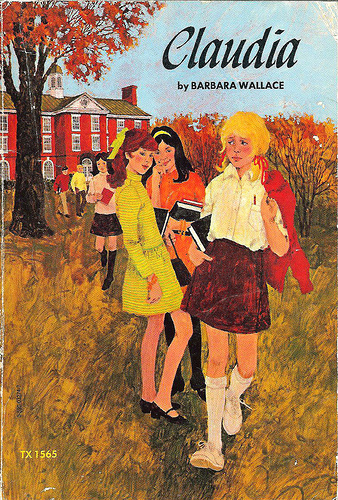
Recently collections of vintage Scholastic Books covers have been popping up online, annotated with the fond memories of the adults who found them at garage sales, scanned and uploaded them. (See links below.)

They're not exactly what you'd call rare books, although people do collect them and sell them on ebay.com. Their longevity isn't so great; the paper yellowed quickly and the covers were easily wrinkled and dog-eared. Scholastic Books' goal was to print cheaply and disseminate widely.

But even as a child, I felt that the stories and cover art tended toward the melancholic. Sure, there were lighthearted stories and emotionally-neutral educational stories: Henry and Ribsy, Encyclopedia Brown, Miss Pickerell Goes Undersea.


But a lot of them were scary or sad, some truly scary and others only superficially so. I was partial to the quasi-scary supernatural mysteries and ghost stories.


And (for reasons that will remain between me and my therapist), I bought a lot of books about Cinderella types and ostracized school girls.


Evidently grownups didn't find these stories particularly dispiriting.

My fourth grade teacher read us Follow My Leader, the story of a boy who picks up a "dud" firecracker only to have it blow up in his face and blind him.

My memory of the book is grueling descriptions of the blinded boy's experience of darkness, helplessness, despair, and loneliness -- until he gets Leader, his seeing eye dog. (And there's still some trouble after that.)

The experience was redeemed by a real-life visit from a local woman who had a seeing eye dog, an Irish setter named "Rusty." I thought Rusty was magnificent, a real hero, for giving up the doggyish joys of romping around and being petted by kids like myself in order to lead his mistress safely through life.

To this day, I'd like to get a dog and name him Rusty. And I won't ever touch a firecracker.

There are about 60 images of Scholastic book covers and illustrations in jl.incrowd's photostream Nostalgia for the Scholastic Book Club, circa '60's & '70's. and another 15 or so in Brent Cox's photostream.

If anyone comes across a Scholastic cookbook for kids with a pigs in blanket recipe, let me know.

Read more...

Say what, Mr. President? One thing we might miss about President George W. Bush

Cut from last night's Rachel Maddow's show due to time constraints is this little review of Bush's unique misuse of the English language.

Vote for your favorite Bushism on Maddow's site. I'm fond of "Our enemies are innovative and resourceful, and so are we. They never stop thinking about new ways to harm our country and our people, and neither do we." But there are oh-so-many more to choose from.

Or watch some of his famous fumbles on tape (sometimes the funniest part is his delivery):


Naturally, pundits have been tracking Bush's flubs since he took office (it's one of those "laugh-to-keep-from-crying situations"). Some of good lists can be found at:

Or peruse a whole compendium of Bushism sites on blogtoplist.com.

Read more...

Refugees: by the numbers
(Bloggers unite to aid refugees day)

11/10/08


Bloggers UniteToday Bloggers Unite and Refugees United have come together in to support, raise money for and spread awareness of the millions of refugees around the world.

Driven from their homes by war, natural disasters, genocide, and persecution, refugees have lost more than just a place to call home. They're frequently deprived of basic human rights such as:Bloggers Unite
  • the right to physical safety
  • the right to food, water, and sanitation
  • the right to work
  • the right to own property
  • the right to legal representation and access to courts
  • the right to move freely outside encampments
  • the right to learn the fate of family members
  • the right to be reunited with family members
  • the right to determine their own futures

Refugees by the numbers
  • 14 million - the number of refugees worldwide. (Source)
  • 24.5 million - the number of internally displaced people (IDP). (Source)
  • 1 in 500 - number of refugees in world population. (Source)
  • 1 in 250 - number of IDP in the world population. (Source)
  • 10,000 - projected number of unaccompanied illegal immigrant children detained by U.S. authorities in 2008. (Source)
  • 4,600 - number of unaccompanied illegal immigrant children detained by U.S. authorities in 2000. (Source)
  • 4 million - number of IDPs in Sudan, the largest IDP population in the world.


  • 14,000 - number of Sudanese refugees living in Djabal camp in the deserts of eastern Chad. (Source)
  • 80 - the percentage of all refugees that are women and children. (Source)
  • 2.5-3.5 million - estimated number of refugees with physical, sensory or mental disabilities. (Source)
  • 2 million - the number of Iraqi refugees in neighboring countries in the five years since the U.S.-led invasion. (Source)
  • 2.7 million - number of internally displaced Iraqis in the five years since the U.S.-led invasion. (Source
  • 400 - number of individual reports of physical abuse by U.S. Border Patrol over the past two years from migrants in custody on the Arizona/Sonora border. (Source)
  • 1951 - date of the UN Convention Relating to the Status of Refugees, the key legal document defining refugee status and rights and the legal obligations of signatory states.
  • 143 - number of countries which had ratified the UN Convention as of 1 March 2006. (Source)
  • Sept. 11, 2001 - date after which many countries passed emergency legistlation curtailing the rights of refugees. (Source)
  • 8,536,500 - number of refugees who are "warehoused" in refugee camps that have been in existence for 10 years or more. (Source)
  • 280,000 - the number of people the U.S. government detained in jails and other facilities last year, more than triple the number of people in detention just nine years ago. (Source)
Take Action:

Read more...

Oxford U. researchers give us their top 10 irritating expressions. What are yours?

11/7/08

It's been a nightmare, but Oxford University researchers, working 24/7, have put together a fairly unique list of the top 10 most irritating phrases. It isn't rocket science, but at the end of the day, this list is, I personally believe, the best one available at this moment in time, absolutely!
Oxford researchers have compiled a new list of most irritating phrases (the paragraph above contains numbers 7, 9, 2, 10, 3, 4, & 6. Makes for some fine writing, doesn't it?)

Researchers use a database called the Oxford University Corpus, which is comprised of books, papers, magazines, broadcast, the internet and other sources. "The database alerts them to new words and phrases and can tell them which expressions are disappearing. It also shows how words are being misused," The Guardian says.

Here they are, the top ten most irritating phrases*:

1. At the end of the day
2. Fairly unique
3. I personally
4. At this moment in time
5. With all due respect
6. Absolutely
7. It's a nightmare
8. Shouldn't of
9. 24/7
10. It's not rocket science

How do you measure "irritating"?


I couldn't find any information about the criteria for the list. What makes a phrase irritating? he frequency of its use? Its grammatical incorrectness?

And how do you decide that one phrase is more irritating than another?

Is redundancy ("I personally") worse than hyperbole ("It's a nightmare")?
Is the phrase "it's not rocket science" more irritating than the synonymous but unlisted phrase "it's not brain surgery"? If so, why?

Speaking of rocket science, I had a friend who was a professor of jet propulsion engineering. She liked to say, "But what do I know? It's not like I'm a rocket scientist -- oh wait, I AM a rocket scientist!"

What's missing from the list, in your opinion?

Which phrases do you find most irritating? My list would include:
1. Could care less
2. doing due diligence
3. Work smarter, not harder
And, after the last presidential debate,
4. "My friends"

*This list appear in a book by Jeremy Butterfield called Damp Squid (title comes from the confusion of "squid" with "squib," a type of firework).

Read more...

Now it can be told! Behind-the-scenes election gossip, courtesy of Newsweek

11/6/08

I tried to talk myself out of writing this post, but I was too weak to resist. Campaigns are all about appearances and brand management, and usually we have no way to know what's really happening off screen.

And it's not like I read this in the National Inquirer: The disclosures are from Newsweek's "How He Did It, 2008," an insider's account of the presidential election put together by a special team of reporters who worked for more than a year "on an embargoed basis, detached from the weekly magazine and Newsweek.com. Everything the project team learns is kept confidential until the day after the polls close."
Here are few excerpts from the current Newsweek.com article:

  • The Obama campaign was provided with reports from the Secret Service showing a sharp and disturbing increase in threats to Obama in September and early October, at the same time that many crowds at Palin rallies became more frenzied. Michelle Obama was shaken by the vituperative crowds and the hot rhetoric from the GOP candidates. "Why would they try to make people hate us?" Michelle asked a top campaign aide.


  • On the Sunday night before the last debate, McCain's core group of advisers—Steve Schmidt, Rick Davis, adman Fred Davis, strategist Greg Strimple, pollster Bill McInturff and strategy director Sarah Simmons-met to decide whether to tell McCain that the race was effectively over, that he no longer had a chance to win. The consensus in the room was no, not yet, not while he still had "a pulse."
  • Palin used low-level staffers to buy clothes on their credit cards. The McCain campaign found out last week when the aides sought reimbursement. One aide estimated that she spent "tens of thousands" more than the reported $150,000, and that $20,000 to $40,000 went to buy clothes for her husband. Some articles of clothing have apparently been lost. An angry aide characterized the shopping spree as "Wasilla hillbillies looting Neiman Marcus from coast to coast," and said the truth will eventually come out when the Republican Party audits its books.


(Make an unemployed writer feel wanted. Subscribe to LilaTovCocktail via email or RSS. It's painless, I swear.)


  • Palin launched her attack on Obama's association with William Ayers, the former Weather Underground bomber, before the campaign had finalized a plan to raise the issue. McCain's advisers were working on a strategy that they hoped to unveil the following week, but McCain had not signed off on it, and top adviser Mark Salter was resisting.

  • McCain also was reluctant to use Obama's incendiary pastor, the Rev. Jeremiah Wright, as a campaign issue. The Republican had set firm boundaries: no Jeremiah Wright; no attacking Michelle Obama; no attacking Obama for not serving in the military.

  • McCain balked at an ad using images of children that suggested that Obama might not protect them from terrorism. Schmidt vetoed ads suggesting that Obama was soft on crime (no Willie Hortons). And before word even got to McCain, Schmidt and Salter scuttled a "celebrity" ad of Obama dancing with talk-show host Ellen DeGeneres (the sight of a black man dancing with a lesbian was deemed too provocative).

According to its website, Newsweek will be publishing more revelations over the next few days on Newsweek.com.

Technorati tags: ,

Read more...

Election tools you can use to cut through
all the bullsh*t

10/18/08

A lot of coding & creativity went into the making of these online election tools and mash-ups: they offer several perspectives on the election, the campaigns and the candidates. Use them to gather or fact-check information or to help you make your final decision on election day.

Count the Lies

Most of the tools in this post are nonpartisan, but there are few exceptions, starting with Count the Lies, located on McCainpedia.org. McCainPedia is a wiki-style site maintained by the Democratic National Committee's Research, Communications, and Internet teams as a way to centralize research and make it available to the general public.


To hold John McCain accountable to his own standard, the Democratic National Committee will count and chronicle the lies here on the McCainPedia's "Count the Lies" page.

Google's Election 08 Tools

The Map Gallery has several election maps on which you can track electoral college vote tallies, Senate and House races, and the campaign trail. The Fundrace Map tracks campaign donor locations so you can see which geographical regions contribute the most.

The Biden's Journey Map tracks vice presidential nominee Joe Biden's journey of life, from birth to the present race for the White House. (There are similar maps for McCain, Obama & Palin.)

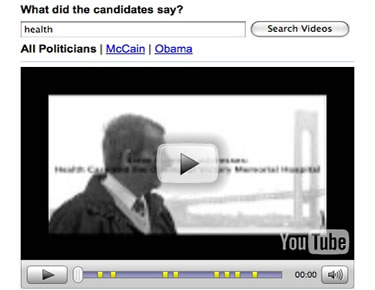
Google Election video search:


Search through computer-generated transcripts of political videos on YouTube to learn what politicians have said on any topic.


Google In Quotes
Search keywords to get a side-by-side comparison of the presidential and vice presidential candidates' statements on the issues.

The Polling Report

An independent, nonpartisan resource on trends in American public opinion, this has all the who's-ahead polls as well as more detailed polls. Updated constantly.


Vote411.org

Vote411.org is the League of Women Voters' “one-stop-shop” for election-related information, providing general and state-specific information on how to find out where to vote in your state, where to grab an absentee ballot, and provides links to the local voting websites in your state.


FactCheck.org was busy during this year's election debates doing live fact checks on the words coming out of each candidates mouth. Go there to find out how true those tv ads are.

The Takeaway's Tools:
Counties That Count The Takeaway's Political Director, Andrea Bernstein, is traveling to swing counties in swing states — spots where this election could be decided. Listen to audio and explore the "counties that count" in an interactive map.

Electoral College Prediction Tracker How will the swing states swing? Play armchair pollster and track the electoral college predictions.

Glassbooth.com is an online tool which "connects you to the 2008 presidential candidate that represents your beliefs the best." The quiz asks for your opinions in areas like civil liberties and domestic security, Iraq and foreign policy, trade and economics, environment and energy and gun control.

My personal feeling is that if you don't know who you're going to vote for at this point, all the quizzes in the world won't help. But then again, I've already voted absentee.


Technorati tags: , , ,

Read more...

To help the poor, let's stop idolizing the rich

10/15/08

"Worst of all is the rich politician who 'suffers' for the common man."

Taylor Caldwell, Answer as a Man (1980)

I don't have anything against rich people -- heck, some of my friends are rich people. They'd be even better friends if they'd share the wealth with me a little more, but for some reason most rich people don't like to do that.

What I do resent is the widespread assumption that rich people -- particularly those who inherited wealth, like George W. Bush or John McCain -- make better leaders.

The only thing we know for sure about the very wealthy is that at some point in history, they or one of their ancestors was in the position of and of the temperament to take advantage of their fellow man's labor or natural resources.


By and large, they are rewarded for this behavior with lives of luxury, the best academic and vocational choices for their children, secure retirements, and general approbation.

But let's not keep handing them the keys to the country. There's no doubt that richest 1% of Americans (who currently hold wealth worth $16.8 trillion) know what kind of leadership is good for them. But there's no evidence that they know what's good for the other 99% of us.

Or, as Barbie Snodgrass of Columbus, OH told George Packer, author of a recent New Yorker article titled "The Hardest Vote: The disaffection of Ohio’s working class":
“Someone who makes two hundred or three hundred thousand a year, who eats a regular meal, who doesn’t have to struggle, who doesn’t worry if the lights are going to be turned out—if he doesn’t walk in your shoes, he can’t understand.”
Today, on Blog Action Day, more than 10,000 sites are blogging about poverty, but I find I can't write about poverty without also writing about wealth and privilege.

It may seem petty to skewer McCain for his inability to remember how many homes or cars he owns or the outfit that Cindy McCain wore at the Republican convention, which Vanity Fair estimated cost between $299,100 and $313,100 -- more than the cost of the average American home, which costs $266,000.

But it's very relevant. If poverty and fiscal restraint are merely academic concepts for you -- if you have no visceral experience of living on a budget, delaying purchases, juggling bill payments, bouncing checks, or not being able to afford to give your children things you'd like them to have -- then you only understand one side of the dynamics of economic power in America.


Poverty is really a lack of power -- not just economic, but also political, physical, and social -- and the least powerful suffer the most: children. Among the 21 most affluent nations, the United States has the highest percentage of children living in poverty. Our rate is more than double that of the country next in line.

Average, ordinary guys

The insult added the injury of politics has got to be rhetorical posturing of rich politicians who pretend to be average Joes. Remember George H.W. Bush's well-publicized love of pork rinds?? This was a man who, as a presidential candidate in 1987 or so, had never seen a grocery store scanner before.

John McCain: "Celebrities don't have to worry about family budgets. But we sure do."
We? We? John McCain's net worth is is $40.4 million, not including Cindy's estimated worth of $100 million (she won't share her tax returns because "she's not a candidate.") The Obamas net worth is $1.3 million, most of it book royalties earned in the past year.
Sarah Palin: "I know what Americans are going through. Todd and I, heck, we're going through that right now even as we speak, which may put me again kind of on the outs of those Washington elite who don't like the idea of just an everyday working class American running for such an office."
The Palin's combined income of nearly a quarter-million dollars last year was five times the median household income for Wasilla's 7,000 residents. They own a single-engine plane, two boats, two personal watercraft and a half-million-dollar, custom-built home on a lake that is worth three times the average of other homes in town.
"If you're pulling in a quarter-mil, own a plane and two boats, and live in a half-million-dollar, custom-built lake house, don't have the audacity to call yourself "an everyday working class American," and then whine about the condescension of the "Washington elite," writes Steve Benen.


Read more...

  © Blogger template Columnus by Ourblogtemplates.com 2008

Back to TOP